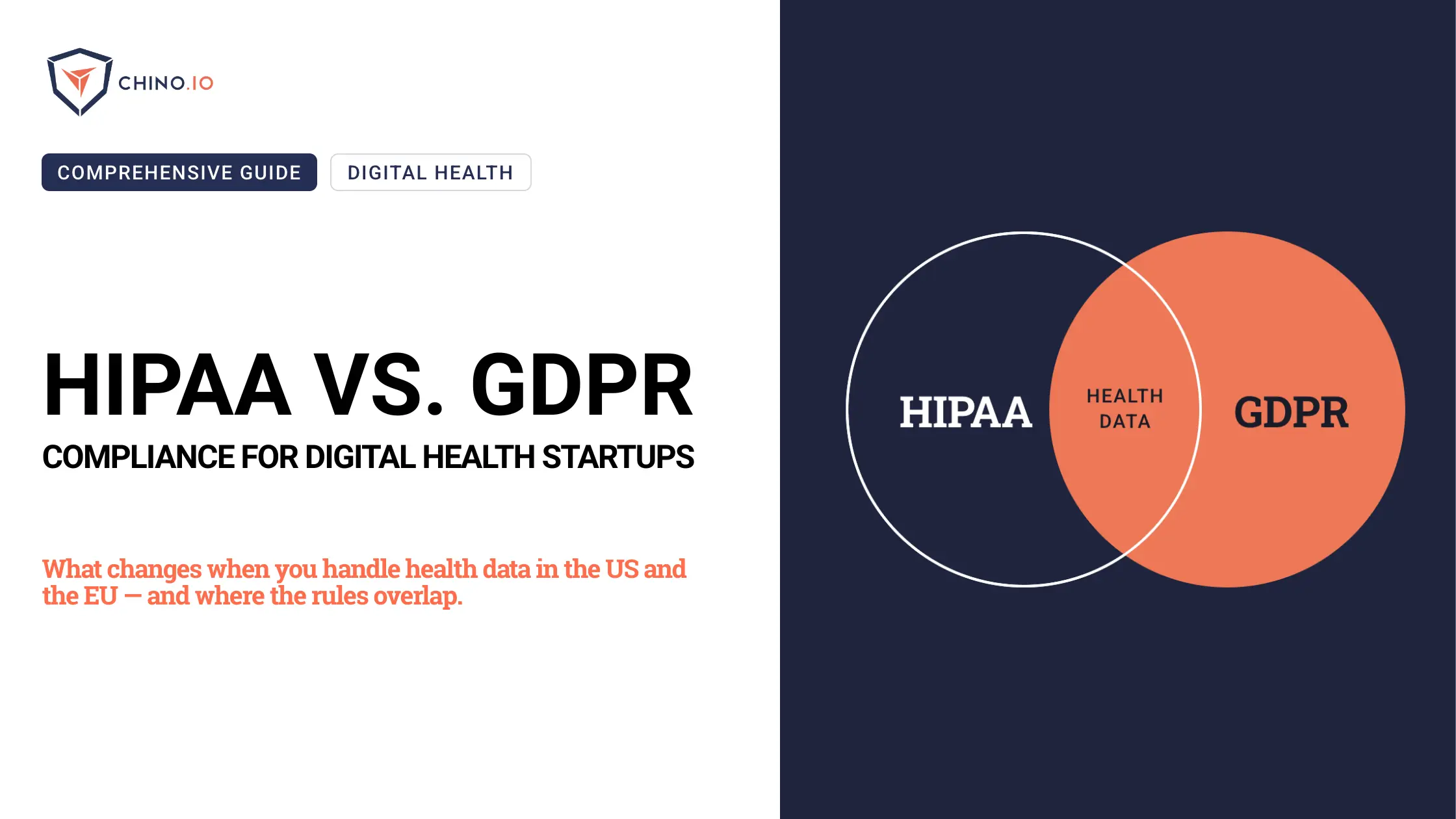

Digital health startups operating globally face a dual regulatory landscape dominated by two primary frameworks: the Health Insurance Portability and Accountability Act (HIPAA) in the United States and the General Data Protection Regulation (GDPR) in the European Union. While HIPAA enforces a narrowly defined, prescriptive security rulebook for protected health information, GDPR mandates broad, privacy-by-design principles across all personal data.
Scaling a digital health startup in the US and EU requires mastering both systems while preparing for emerging standards like the EU European Health Data Space (EHDS) and state-level U.S. health data laws.
Core Differences: HIPAA vs. GDPR at a Glance
Understanding the structural differences between U.S. and EU privacy laws is essential for aligning technical architecture, legal frameworks, and product roadmaps.
Technical and Legal Requirements Under HIPAA
HIPAA compliance relies on establishing strict administrative, physical, and technical safeguards to secure ePHI across software infrastructure.
- Business Associate Agreements (BAAs): Digital health vendors must sign legally binding BAAs with any cloud hosting provider, analytics platform, or sub-processor that interacts with PHI.
- Technical Safeguards: Access controls, role-based authorization, end-to-end encryption (AES-256 at rest, TLS 1.3 in transit), audit controls, and multi-factor authentication (MFA) are non-negotiable.
- Administrative Safeguards: Formal security management processes, security officer designations, regular vulnerability assessments, and mandatory employee training.
- Penalty Risks: Unintentional non-compliance or failure to conduct regular risk assessments leads to severe financial penalties enforced by the HHS Office for Civil Rights (OCR).
Legal Principles and Mandates Under GDPR
GDPR treats health data as a "special category of personal data" under Article 9, prohibiting its processing unless specific legal exemptions and explicit user consent conditions are met.
- Lawful Basis for Processing: Startups must establish an explicit legal ground (e.g., explicit user consent under Article 9(2)(a) or public health necessity) before collecting health metrics.
- Data Protection Impact Assessments (DPIAs): Mandatory documented evaluations detailing the necessity, proportionality, and risk mitigation strategies of all health data processing.
- Data Subject Rights Architecture: Product infrastructure must programmatically support user requests for data export (portability), restriction of processing, and complete data deletion ("Right to be Forgotten").
- Data Localization & Cross-Border Transfers: Storing EU patient data on foreign server infrastructure requires validated transfer mechanisms such as the EU-U.S. Data Privacy Framework or Standard Contractual Clauses (SCCs).
Pro Tip: Position data privacy as a product feature rather than a legal bottleneck. Digital health companies that publish transparent compliance architecture attract higher enterprise trust and experience faster procurement cycles in B2B healthcare markets.
5-Step Compliance Roadmap for Digital Health SMEs
Staying compliant while scaling requires a proactive and systematic engineering approach.
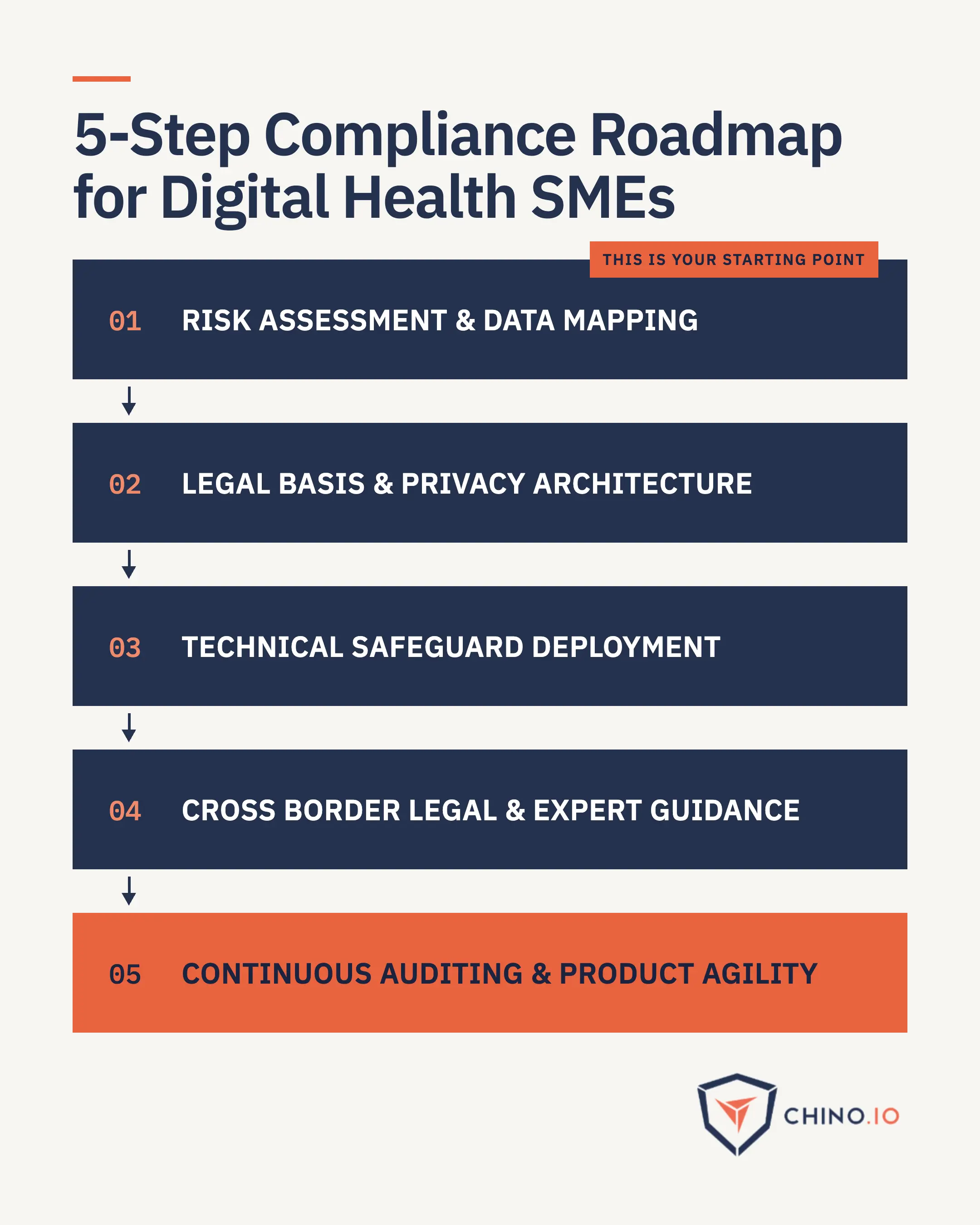
1. Conduct Data Mapping and Risk Assessments
Perform data flow mapping to trace every point where data is ingested, processed, and stored.
- HIPAA: Execute a Security Risk Assessment (SRA) to locate vulnerabilities in ePHI pipelines.
- GDPR: Conduct a Data Protection Impact Assessment (DPIA) and document data anonymization vs. pseudonymization protocols.
2. Establish Clear Legal Consent Mechanisms
Build robust user onboarding flows with explicit opt-ins, transparent terms, and unambiguous privacy notices. Maintain granular consent records to satisfy GDPR Article 7 audit standards.
3. Deploy Unified Technical Safeguards
Implement security architectures that address both frameworks simultaneously:
- Enforce robust encryption at rest and in transit.
- Restrict access via strict Role-Based Access Controls (RBAC) and least-privilege principles.
- Maintain immutable audit logs tracking every read, write, and deletion request.
4. Appoint required experts (DPO, privacy officer and EU representative)
You need to appoint a suitable person to assist with privacy matters. In the EU this is a Data Protection Officer (DPO), while under HIPAA to it’s a Privacy Officer. DPOs should be independent whereas Privacy Officers can be internal or external. If you are a US company looking to launch in Europe, you may need to appoint an EU representative.
5. Establish Continuous Compliance Auditing
Regulations, cloud services, and codebases undergo constant changes. Schedule quarterly compliance reviews, automated code dependency scans, and regular penetration tests to preserve continuous audit-readiness.
Future Trends in Health Data Regulation
The regulatory environment for health data continues to expand beyond traditional clinical settings.
- United States Health Data Expansion: Federal agencies like the FTC enforce strict oversight on consumer health apps via the Health Breach Notification Rule. State-level privacy statutes—such as Washington's My Health My Data Act—extend health-privacy mandates to non-covered entities collecting consumer health metrics.
- EU European Health Data Space (EHDS): Regulation (EU) 2025/327 introduces mandatory interoperability standards (European Electronic Health Record Exchange Format) and strict rules for primary and secondary health data reuse across EU member states. Startups must design systems that allow secure, privacy-preserving data access.
FAQs
Can a digital health startup be compliant with both HIPAA and GDPR simultaneously?
Yes. Startups achieve dual compliance by implementing privacy-by-design infrastructure. This includes technical encryption, signing BAAs with U.S. vendors, using Standard Contractual Clauses (SCCs) for international transfers, maintaining DPIAs, and honoring individual user privacy rights.
Is consent required under both HIPAA and GDPR for health data?
No. HIPAA permits the use of ePHI for treatment, payment, and healthcare operations without prior patient consent. In contrast, GDPR requires an explicit legal basis—most commonly explicit consent or public interest exemptions—to process health data (also called special category data).
Does HIPAA apply to consumer wellness and fitness tracking apps?
Not automatically. HIPAA only applies if the app is being used for or on behalf of a "Covered Entity" (such as a health plan, healthcare provider, or healthcare clearinghouse) or acts as a "Business Associate." However, non-HIPAA wellness apps in the U.S. are still subject to FTC privacy enforcement and state laws like Washington's My Health My Data Act.
Streamline Your Compliance With Chino.io Today
Discover our
Templates
Read our Latest Industry Insights
Discover insights from our expert writers.